
If you have a website, you’ve probably heard the term SEO many times. But what exactly is SEO, and how does it work in 2026?
SEO, or Search Engine Optimization, is the process of improving a website so that search engines can better understand, trust, and rank its pages for relevant searches.
The goal is simple: get your website in front of the right people when they are searching for products, services, information, or solutions that your business offers.
But SEO in 2026 is much more than adding keywords to a webpage. Search engines are becoming better at understanding context, user intent, content quality, website experience, and entities. At the same time, AI-powered search experiences are changing how people discover information online.
In this guide, we’ll explain what SEO is, how it works, the most important SEO factors in 2026, and how businesses can build a sustainable organic search strategy.
What Is SEO?
SEO (Search Engine Optimization) is a collection of strategies and techniques used to improve a website’s visibility in organic search results.
When someone searches on Google or another search engine, the search engine needs to determine which pages are most relevant and useful for that query.
SEO helps search engines:
- Discover your website
- Crawl and understand your pages
- Determine what your content is about
- Evaluate your website’s quality and credibility
- Match your pages with relevant search queries
- Understand which pages deserve visibility
For example, imagine you own a local plumbing company.
Someone searches:
“plumber near me”
If your website is properly optimized for local search, your business may have an opportunity to appear in relevant organic results and local search features.
The same principle applies to ecommerce stores, SaaS companies, agencies, professional services, publishers, and almost every other type of website.
How Does SEO Work?
SEO works by helping search engines understand your website and providing users with a better search experience.
A simplified SEO process looks like this:
Crawling → Indexing → Understanding → Ranking → Traffic → Conversions
Let’s look at each stage.
1. Crawling
Search engines use automated programs, commonly called crawlers or bots, to discover webpages.
Google’s crawler, for example, follows links and uses various signals to discover new or updated content.
If search engines cannot properly crawl your website, important pages may never be discovered or processed correctly.
Technical SEO plays an important role here.
Common crawling problems include:
- Broken internal links
- Incorrect robots.txt rules
- Poor website architecture
- Server errors
- Incorrect redirects
- Duplicate URLs
- Poorly implemented JavaScript
- Orphan pages
2. Indexing
After discovering a webpage, a search engine may analyze and store information about that page in its index.
Being indexed doesn’t necessarily mean that a page will rank well.
A page can be indexed but still receive little or no organic traffic because it doesn’t sufficiently satisfy the search intent or compete effectively against other pages.
That’s why indexing and ranking are two different things.
3. Understanding Search Intent
Modern search engines are increasingly focused on understanding what users actually want.
For example, someone searching for:
“best running shoes”
probably wants to compare products.
Someone searching:
“how to clean running shoes”
is looking for instructions.
Someone searching:
“Nike running shoes”
may be looking for a specific brand or product category.
Understanding search intent helps you create the right type of content for each keyword.
The four common types of search intent are:
- Informational — The user wants information.
- Navigational — The user wants to find a particular website or brand.
- Commercial investigation — The user is researching before making a purchase.
- Transactional — The user is ready to take an action or make a purchase.
Successful SEO strategies align content with the intent behind the search.
The Main Types of SEO
SEO is not one single activity. It consists of several areas that work together.
1. On-Page SEO
On-page SEO focuses on optimizing elements on your website.
This can include:
- Page titles
- Headings
- Content
- URLs
- Internal links
- Images and alt text
- Meta descriptions
- Structured data
- Keyword targeting
- Content organization
The objective isn’t simply to insert keywords repeatedly.
Instead, your content should clearly communicate the topic while genuinely helping the user.
2. Technical SEO
Technical SEO focuses on the technical foundation of your website.
Important areas include:
- Website crawling
- Indexing
- Site architecture
- Page speed
- Mobile usability
- Core Web Vitals
- HTTPS
- Canonical URLs
- XML sitemaps
- Redirects
- Structured data
- JavaScript SEO
A technically strong website makes it easier for search engines to discover and process your content.
3. Off-Page SEO
Off-page SEO involves signals and activities that happen outside your website.
One of the best-known examples is link building.
When reputable websites link to your content, those links can help search engines discover pages and may contribute to how they evaluate the authority and relevance of a site.
However, quality matters more than simply collecting a large number of links.
Other off-page activities can include:
- Digital PR
- Brand mentions
- Relevant partnerships
- Industry citations
- Community engagement
- Reputation building
The goal should be building genuine authority rather than manipulating search rankings.
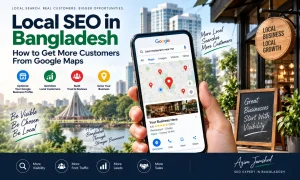
4. Local SEO
If you operate a local business, Local SEO can be extremely important.
Local SEO helps businesses improve their visibility for searches connected to a specific location.
Examples include:
- “SEO agency in Dhaka”
- “dentist near me”
- “best restaurant in Gulshan”
- “plumber in London”
Important local SEO activities include:
- Optimizing your Google Business Profile
- Maintaining consistent business information
- Building relevant local citations
- Creating location-focused content
- Earning local reviews
- Building relevant local links
- Optimizing location and service pages
For businesses that depend on local customers, strong Local SEO can generate highly targeted leads.
What Are the Most Important SEO Factors in 2026?
SEO doesn’t have one universal checklist that guarantees rankings.
Search engines use many systems and signals, and ranking factors can vary depending on the query.
However, several areas remain particularly important.
High-Quality, Helpful Content
Content should be created primarily to help people—not simply to attract search engine traffic.
Good content should:
- Answer the user’s question
- Be accurate and useful
- Demonstrate appropriate expertise
- Be easy to understand
- Provide original value
- Match search intent
- Be updated when necessary
Publishing hundreds of low-value AI-generated articles isn’t a substitute for a thoughtful content strategy.
Search Intent
Before creating content, ask:
“What does someone searching this keyword actually want?”
If the search results are dominated by product pages, publishing a generic 2,000-word article may not be the best strategy.
Likewise, if users are clearly looking for a detailed guide, a thin sales page may struggle to satisfy the query.
Website Experience
A website should be fast, accessible, mobile-friendly, secure, and easy to navigate.
Users should be able to quickly find what they’re looking for.
Important considerations include:
- Mobile usability
- Page loading performance
- Core Web Vitals
- Clear navigation
- Readable content
- Secure browsing
- Minimal intrusive elements
Internal Linking
Internal links connect pages on your website.
A well-planned internal linking structure can help:
- Search engines discover pages
- Users navigate your website
- Establish relationships between topics
- Distribute internal authority
- Strengthen topical organization
For example, a blog post about “Shopify SEO” could naturally link to a dedicated Shopify SEO service page.
Backlinks and Authority
Links from relevant and trustworthy websites can still be valuable.
Instead of focusing on obtaining as many backlinks as possible, focus on earning links that make sense for your industry.
Useful link acquisition strategies can include:
- Digital PR
- Original research
- Useful resources
- Expert contributions
- Industry partnerships
- High-quality guest contributions
Avoid relying on spammy link schemes.
How AI Is Changing SEO in 2026
One of the biggest changes in search is the increasing role of AI-powered search experiences.
Users may encounter AI-generated answers and summaries alongside traditional search results.
This means businesses need to think beyond traditional “10 blue links.”
Your content should be:
- Clear
- Accurate
- Well structured
- Easy to understand
- Supported by trustworthy information
- Focused on specific user questions
- Demonstrably useful
This is also where concepts such as Generative Engine Optimization (GEO) and AI search optimization are becoming increasingly relevant.
Rather than trying to “hack” AI systems, businesses should focus on making their information easy for search engines and AI systems to understand and accurately represent.
Does AI-Generated Content Hurt SEO?
Not automatically.
The important question is not simply who or what produced the content.
The bigger question is whether the content provides genuine value and meets the needs of users.
AI can help with tasks such as:
- Brainstorming
- Research organization
- Content outlines
- Drafting
- Data analysis
- Editing
But blindly publishing generic AI-generated content can result in pages that offer little original value.
A strong content process combines technology with human expertise, fact-checking, editing, and real-world experience.
How Long Does SEO Take?
SEO is generally a long-term marketing strategy.
There is no guaranteed timeline because results depend on factors such as:
- Website age
- Competition
- Industry
- Website authority
- Technical health
- Content quality
- Search intent
- Backlink profile
- Existing organic visibility
- SEO strategy and execution
Some changes can produce improvements relatively quickly, while competitive keywords may take considerably longer.
The right approach is to focus on sustainable growth rather than expecting overnight rankings.
SEO vs. Paid Advertising
SEO and paid advertising can both generate website traffic, but they work differently.
With paid advertising, you typically pay for visibility.
With SEO, you invest in improving your website’s organic visibility.
SEO Advantages
- Can generate long-term organic traffic
- Builds search visibility over time
- Can support brand authority
- Doesn’t require paying for every organic click
- Can create a sustainable acquisition channel
Paid Advertising Advantages
- Can generate traffic quickly
- Allows precise campaign targeting
- Useful for testing offers
- Can scale visibility with advertising budget
For many businesses, the best marketing strategy isn’t SEO vs. paid advertising.
It can be SEO + paid advertising, depending on goals and budget.
How to Create an SEO Strategy in 2026
A practical SEO strategy can be built around these steps:
Step 1: Define Your Business Goals
Determine what SEO should accomplish.
Do you want:
- More leads?
- More sales?
- More local customers?
- More ecommerce revenue?
- More brand visibility?
Your SEO strategy should support business outcomes—not just rankings.
Step 2: Research Your Audience
Understand what your potential customers search for.
Look for:
- Questions
- Problems
- Products
- Services
- Comparisons
- Locations
- Buying-related searches
Step 3: Perform Keyword Research
Find keywords that are relevant to your business and have realistic opportunities.
Don’t focus exclusively on high-volume keywords.
A lower-volume keyword with strong commercial intent can sometimes be more valuable than a high-volume informational keyword.
Step 4: Audit Your Website
A technical and content audit can reveal problems affecting organic performance.
Check:
- Indexing
- Crawlability
- Site architecture
- Duplicate content
- Broken links
- Page speed
- Metadata
- Content quality
- Internal linking
- Structured data
Step 5: Create Useful Content
Develop content around topics your audience genuinely cares about.
Build topic clusters rather than publishing unrelated articles.
For example, an ecommerce business selling skincare products might create content around:
Skincare SEO → Product SEO → Category SEO → Ecommerce SEO → Technical SEO
Step 6: Optimize Your Important Pages
Improve your:
- Homepage
- Service pages
- Product pages
- Category pages
- Location pages
- Blog content
Make sure each important page has a clear purpose and target audience.
Step 7: Build Authority
Earn relevant mentions and backlinks through useful resources, digital PR, partnerships, and original content.
Step 8: Measure Results
Track meaningful SEO metrics such as:
- Organic clicks
- Organic impressions
- Rankings
- Leads
- Sales
- Conversion rate
- Indexed pages
- Search visibility
Ultimately, business results matter more than vanity metrics.
Common SEO Mistakes to Avoid in 2026
Avoid these common mistakes:
Keyword Stuffing
Repeating the same keyword excessively can make content unnatural and doesn’t create a better user experience.
Publishing Thin Content
Creating many pages without providing meaningful value can waste resources and create a poor website experience.
Ignoring Technical SEO
Excellent content can’t perform at its best if search engines struggle to crawl, render, or understand your website.
Buying Low-Quality Backlinks
Cheap backlink packages can create unnecessary risk and rarely provide sustainable value.
Ignoring Search Intent
Targeting a keyword without understanding what users expect to see can lead to poor performance.
Focusing Only on Rankings
A ranking is not the final business goal.
Traffic that doesn’t generate leads, sales, or meaningful engagement may have limited business value.
Is SEO Still Worth It in 2026?
Yes—but the way businesses approach SEO is changing.
Search is becoming more sophisticated, competition is increasing, and AI is changing how users discover information.
That makes a strategic SEO approach more important—not less.
Businesses that invest in:
- High-quality content
- Strong technical foundations
- Search intent
- Topical authority
- Local visibility
- Brand credibility
- User experience
- AI search readiness
can build a stronger organic presence over time.
Final Thoughts
SEO is the process of making your website easier for search engines to discover, understand, evaluate, and connect with relevant users.
In 2026, successful SEO isn’t about finding one secret ranking trick.
It’s about building a useful, trustworthy, technically sound, and authoritative website that deserves to be visible when people search.
Whether you run a local business, ecommerce store, SaaS company, or professional service business, a well-planned SEO strategy can become a powerful long-term source of qualified traffic and customers.
Need help improving your website’s organic visibility? A professional SEO strategy can help identify technical problems, content opportunities, keyword gaps, and growth opportunities tailored to your business.