
Get Found by Customers Searching for Your Business
Your ecommerce store needs more than traffic. It needs the right visitors—people actively searching for the products you sell and ready to take the next step.
I provide Ecommerce SEO in Bangladesh for online stores that want stronger product visibility, better organic search presence, and more qualified opportunities to generate sales.
My approach combines SEO strategy with hands-on ecommerce development experience, so I look beyond keywords and rankings. I consider your products, categories, website structure, technical health, customer journey, search intent, and business goals.

Target buyers actively searching for transactional & product queries.
Shopify & WooCommerce code-level expertise to resolve crawl/index issues.
Scale locally across BD or expand into global e-commerce markets.
Beyond Vanity Metrics
Ranking on Google is useful, but a ranking by itself does not create a successful ecommerce business.
The real question is: Are the right customers finding the right products at the right stage of their buying journey?
A store can receive organic traffic and still struggle to generate meaningful business if its pages target the wrong searches, product categories are difficult to discover, or technical problems prevent important pages from being properly crawled and indexed.

Fiverr Seller
Upwork Freelancer
Effective ecommerce SEO connects several elements:
Understanding what the customer actually wants
Helping relevant products appear for valuable searches
Building strong landing pages around broader commercial searches
Attracting visitors who are relevant to your products
Making pages easy to understand and navigate
Helping visitors move naturally toward purchase
Ensuring search engines can efficiently access and understand your store
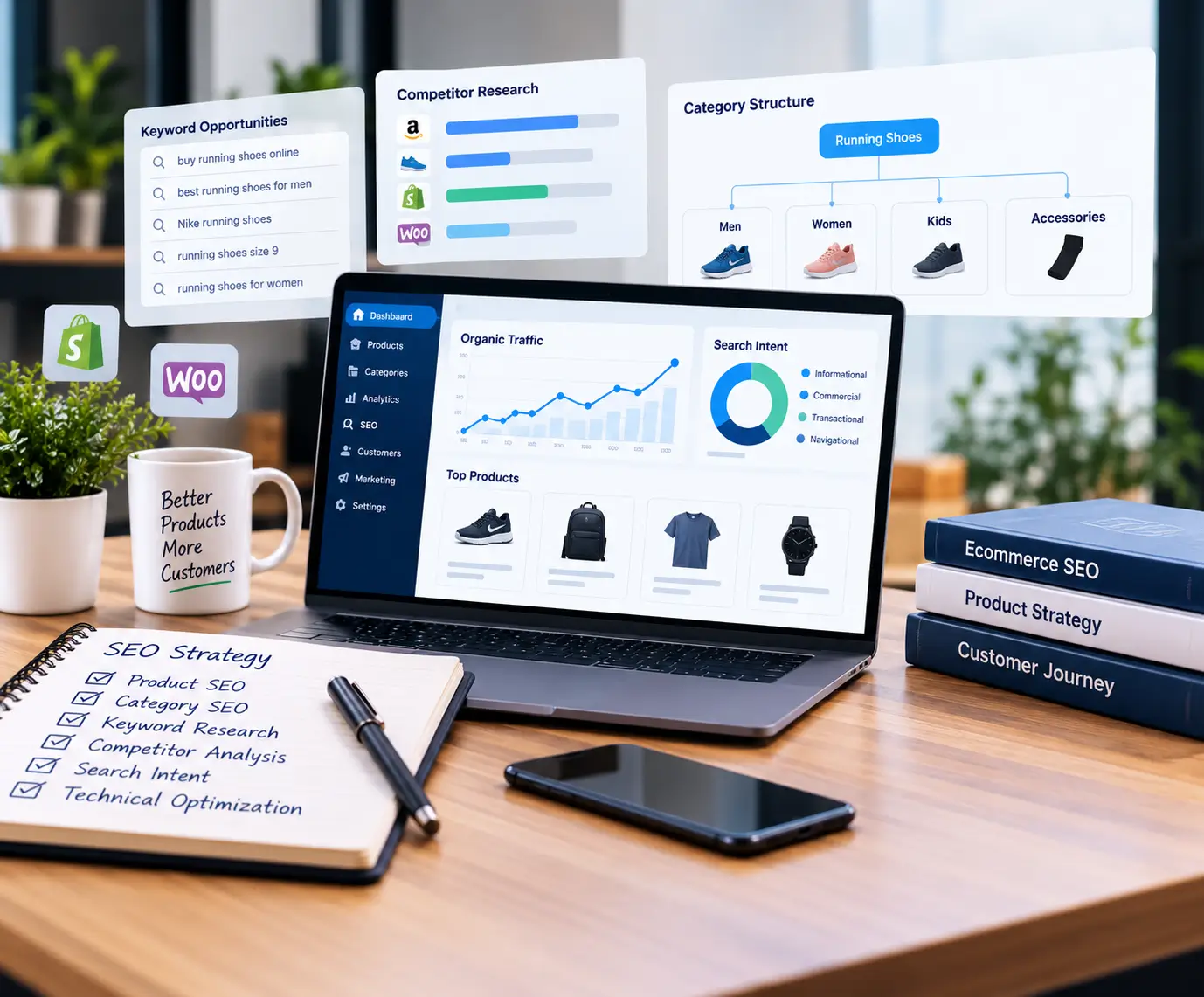
Tailored Architecture
Every ecommerce website is different. A fashion store, electronics retailer, cosmetics brand, furniture business, and B2B supplier can all have completely different search behavior—even when they use the same ecommerce platform. That’s why I don’t start with a generic SEO checklist.
The real question is: Are the right customers finding the right products at the right stage of their buying journey?
A store can receive organic traffic and still struggle to generate meaningful business if its pages target the wrong searches, product categories are difficult to discover, or technical problems prevent important pages from being properly crawled and indexed.
What are you trying to grow? That could be product sales, category visibility, brand awareness, organic leads, international customers, or a specific product line.
I look at how potential customers search before, during, and near the buying decision. Someone searching for "best running shoes" has a different intent from someone searching for "buy Nike running shoes size 9."
Your website architecture affects both users and search engines. I review how products, categories, collections, filters, and supporting content are organized so important pages have a logical relationship.
Keyword research isn't about collecting hundreds of phrases. It's about identifying searches that make sense for your products, market, competition, and commercial objectives.
Competitors can reveal valuable opportunities—especially keywords, product categories, content topics, and search areas where your store is currently underrepresented.
Search volume is only one part of the decision. A lower-volume keyword with strong buying intent may be more commercially useful than a high-volume keyword that attracts people who are only looking for information.
Engineering Scalability
Technical problems can quietly limit an ecommerce website’s organic visibility.
A store may have excellent products and well-written descriptions, but if important pages cannot be properly crawled, indexed, understood, or loaded efficiently, SEO performance can suffer. My ecommerce technical SEO work can cover areas such as:
Crawlability
Indexation
Website architecture
Internal linking
Canonical URLs
Duplicate content
Product variations
XML sitemaps
Robots.txt
Core Web Vitals
Page speed
Mobile usability
Structured data / schema
Ecommerce URL structure
Imagine an online store with thousands of products. If search engines encounter unnecessary duplicate URLs, poorly controlled filters, inconsistent canonicals, or weak internal linking, valuable pages may not receive the attention they deserve. The goal is not to make your website technically complicated.
Revenue Engines
Product and category pages are often the most commercially important pages on an ecommerce website. They should not be treated as simple templates that automatically become SEO-friendly after products are uploaded. I optimize important ecommerce pages around both search intent and customer experience.
Depending on the store and product, optimization can include:
A product page should quickly communicate what the product is, who it is for, and why the visitor should consider it.
Category pages can target broader commercial searches while helping users discover related products. I focus on:
The objective is to avoid creating pages that are optimized only for search engines. The page should still make sense to someone who arrives ready to shop.
Buyer Intent Mapping
Effective ecommerce keyword research goes beyond search volume. I organize keyword opportunities around the different ways customers search for products.
These indicate that someone is researching products, brands, features, or options before making a decision.
These are closer to the purchasing stage and may include terms such as: Buy - Order - Shop - Price - Discount - Online - Near me - Specific product names
These focus directly on individual products, models, brands, features, sizes, materials, or specifications.
These represent broader product groups and can be valuable for collection or category pages.
Longer, more specific searches can reveal exactly what a customer wants. For example, instead of targeting only "office chair," an ecommerce store may find opportunities around searches describing the chair's purpose, features, material, size, or intended user.
Not every potential customer starts with a purchase query. Guides, comparisons, buying advice, and educational content can help a brand reach customers earlier in the journey.
For businesses targeting Bangladesh or specific cities, location modifiers can be valuable where they reflect genuine search behavior.
Competitor research can reveal relevant search terms and topics where competing stores have visibility but your website has limited or no presence.
The important point: search volume alone doesn’t determine whether a keyword is worth targeting. Relevance, intent, competition, business value, and the page’s ability to satisfy the search all matter.
Revenue Engines
Good on-page SEO gives search engines clearer context about what your ecommerce website offers.
But it should never result in awkward writing or pages created primarily for algorithms.
I focus on:
For example, a product page should naturally establish the relationship between the product, brand, category, features, use case, and customer need. Likewise, category pages should clearly explain what the category contains and how the products within it relate to the customer’s search.
Technical Advantage
One of my biggest advantages is that I don’t look at ecommerce SEO only from the marketing side. I also understand the technical environment in which the SEO needs to be implemented. My hands-on experience includes:
WordPress
WooCommerce
Shopify
Elementor
Ecommerce website development
Website structure
Technical website issues
Performance optimization
SEO implementation
Product and category architecture
Duplicate pages
Internal links
URL structures
Schema implementation
Page speed
Metadata
Templates
Ecommerce filters
Product variations
Market Flexibility
Ecommerce SEO doesn’t have to stop at Bangladesh. The strategy should follow your actual market.
For a Bangladesh-focused business, SEO may concentrate on:
For businesses targeting international customers, the strategy may expand into:
There is no universal international SEO setup that works for every ecommerce store. The right approach depends on where you sell, which products you offer, how your website is structured, and how your target customers search.
Whether your goal is to grow an online store in Bangladesh or expand into international markets, Ecommerce SEO in Bangladesh can be structured around the market you actually want to reach.
Proven Track Record
SEO experience becomes valuable when it helps solve real website problems.
I’ve completed 47+ SEO projects, worked with clients and businesses across 17+ countries, and built my professional experience across SEO, ecommerce development, WordPress, WooCommerce, Shopify, and website optimization.
I’m also a Fiverr Level 2 Seller and Upwork Top Rated Freelancer.
It means you aren’t hiring someone who looks at ecommerce SEO only as a list of keywords.
I understand that a store has products to sell, customers to serve, technical limitations to manage, and business objectives to achieve.
My approach is built around practical SEO decisions:
I don’t promise guaranteed rankings or guaranteed revenue. Search performance depends on many factors, including competition, website quality, search demand, industry changes, and implementation. What I can provide is a structured SEO process designed around your actual website and business goals.
Client Benefits
Working across different markets teaches you an important lesson:
SEO cannot be separated from the business behind the website.
My ecommerce SEO approach focuses on:
Recommendations are based on real website structures, SEO problems, ecommerce platforms, and implementation considerations.
You should understand what is being worked on, why it matters, and what the next priorities are.
These focus directly on individual products, models, brands, features, sizes, materials, or specifications.
From WordPress and WooCommerce to Shopify and custom ecommerce structures, technical knowledge helps identify problems that may otherwise be overlooked.
The goal is to attract relevant searchers and create better opportunities—not simply collect ranking keywords.
SEO takes time and requires ongoing improvement. I focus on clear priorities rather than unrealistic promises.
The objective is to build a stronger search foundation that can continue supporting your business as your product range, content, and market develop.
Scope Breakdown
The exact scope depends on the website, but an ecommerce SEO campaign may include:
The priorities are determined after understanding the current condition of your website.
Ideal Fit
Ecommerce businesses in Bangladesh
WooCommerce store owners
Shopify store owners
WordPress ecommerce websites
Online retailers
D2C brands
MetadataBusinesses targeting customers across Bangladesh
Bangladeshi businesses targeting international markets
Stores struggling with organic traffic
Stores with poor product visibility
Ecommerce websites with technical SEO problems
Businesses wanting to reduce dependence on paid acquisition
Ecommerce SEO is an ongoing process rather than a one-time task. The timeline depends on your website’s current technical condition, competition, authority, target keywords, content, and implementation speed. Some improvements can be addressed quickly, while broader organic growth requires consistent work over time.
Yes. WooCommerce is one of the ecommerce platforms I work with. SEO work can include product and category optimization, technical SEO, site structure, internal linking, metadata, schema, performance, and other issues relevant to the store.
Yes. I have hands-on experience with Shopify SEO and can work on areas such as product pages, collections, keyword targeting, technical SEO, internal linking, metadata, and ecommerce site structure.
Yes. An ecommerce SEO strategy can be designed for Bangladesh, international markets, or both. Depending on the business, the strategy may involve country targeting, localized keyword research, multilingual or multiregional SEO, and appropriate website architecture.
The scope can include SEO strategy, keyword research, competitor research, technical SEO, product and category optimization, on-page SEO, internal linking, structured data, content opportunities, and performance improvements. The exact priorities depend on the website.
Yes. Technical SEO can cover crawlability, indexation, canonicalization, duplicate content, URL structures, XML sitemaps, robots.txt, internal linking, mobile usability, performance, structured data, and other ecommerce-specific issues.
No. I don’t guarantee rankings, traffic, or revenue. SEO performance depends on competition, search demand, website quality, implementation, industry changes, and many other factors. The focus is on building a technically sound, relevant, user-focused SEO strategy.
Send me your ecommerce website and briefly explain what you want to improve. I can use that information to understand your current situation and determine the most relevant SEO priorities for your store.
Your ecommerce website already contains the products, categories, and business expertise. The next step is making sure potential customers can discover the right pages through search.
I can review your current SEO condition, identify the most important opportunities, and build an ecommerce SEO strategy around your products, market, platform, and business goals.
No guaranteed rankings. No one-size-fits-all checklist. Just a practical SEO strategy designed around your ecommerce website and the customers you want to reach.