Your customers don’t all search in the same way. Some type product keywords into Google, some ask direct questions, and others use AI-powered tools to research products and compare options.
For WooCommerce store owners, understanding SEO vs AEO vs GEO helps clarify how to improve visibility across these different search experiences.
I’m Azim Jamshed, an SEO specialist working with website optimization, ecommerce SEO, technical SEO, and AI search visibility. I help businesses identify practical opportunities to improve how their websites are discovered, understood, and presented to potential customers.
Whether you sell in Bangladesh or target international customers, the right strategy starts with your website, your products, your audience, and the way people search before buying.
What Is the Difference Between SEO, AEO and GEO?
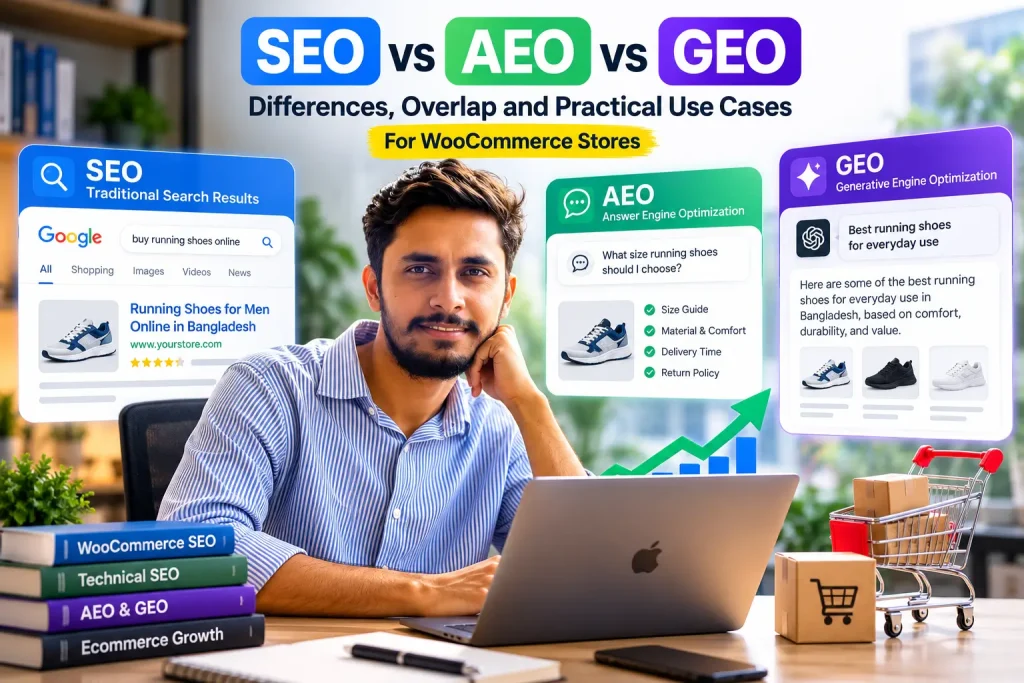
SEO improves a website’s ability to appear in traditional search results. AEO focuses on making content useful and accessible for direct answers. GEO focuses on improving the chances that relevant content will be discovered, understood, cited, or referenced by generative AI search experiences.
Although they have different emphases, these approaches overlap. All benefit from useful content, accessible pages, clear information, and a website that search systems can understand.
Search Engine Optimization (SEO)
SEO helps your website earn visibility in traditional organic search results through technical improvements, relevant content, search intent alignment, and website authority.
WooCommerce example: Optimize a product category for a commercial keyword such as “men’s running shoes in Bangladesh,” improve product-page titles, and resolve technical indexing problems.
Answer Engine Optimization (AEO)
AEO focuses on structuring useful information so search and answer systems can identify and present concise answers to users’ questions.
WooCommerce example: Answer questions about sizing, delivery, returns, compatibility, product materials, and product care clearly on relevant pages.
Generative Engine Optimization (GEO)
GEO focuses on improving the clarity, relevance, credibility, and discoverability of content for generative AI search experiences that synthesize information from multiple sources.
WooCommerce example: Publish accurate product specifications, helpful buying guides, clear brand information, and well-supported comparisons that help customers evaluate products.
SEO vs AEO vs GEO: Quick Comparison
| Area | SEO | AEO | GEO |
|---|---|---|---|
| Main focus | Organic search visibility | Useful direct answers | Visibility in generative AI experiences |
| Common discovery experience | Google and Bing search results | Featured answers, snippets, and answer interfaces | AI-generated responses and search summaries |
| Content emphasis | Search intent, relevance, and depth | Clear questions and direct answers | Context, trustworthy information, and useful synthesis |
| Technical priorities | Crawling, indexing, architecture, performance | Accessible content and clear information structure | Crawlability, understandable content, and reliable source information |
| Ecommerce application | Product and category rankings | Product questions and purchase guidance | Product discovery, comparisons, and brand understanding |
| Business objective | Qualified organic traffic | Help users find answers efficiently | Improve opportunities for discovery and consideration |
These are practical distinctions, not completely separate disciplines. Features and selection methods vary by platform, and none of the three approaches guarantees a ranking, featured answer, or AI citation.
Why WooCommerce Stores Need a Connected Search Strategy
A WooCommerce store can have hundreds or thousands of products and still struggle to attract qualified organic visitors.
The cause might be technical rather than editorial. Product variations may create confusing URLs, category pages may lack useful content, important pages may not be indexed, or product information may not answer the questions buyers ask before purchasing.
Traditional SEO helps address discoverability and relevance. AEO helps make important product information easier to identify and use. GEO extends the strategy to generative search experiences.
A connected strategy helps you avoid treating each new search feature as a completely separate marketing channel.
Make Product Pages More Useful
Product pages should communicate what an item does, who it is for, which specifications matter, and what a buyer needs to know before purchasing.
Improve Category-Level Relevance
Category pages should help shoppers compare products and understand the available options. Relevant category descriptions, helpful filters, and logical internal links support both usability and search understanding.
Resolve Technical Barriers
Search visibility can suffer when important pages are blocked, canonicalized incorrectly, duplicated, slow, or difficult to discover through internal links.
Answer Questions Before Customers Leave
Shipping, returns, sizing, compatibility, installation, warranties, and maintenance questions can influence purchasing decisions. Put accurate answers where customers need them.
Prepare for Different Search Experiences
Customers may discover your products through traditional results, shopping interfaces, direct-answer features, or generative AI tools. A strong foundation makes your website more useful across these experiences without relying on any single platform.
Find Out What Your WooCommerce Store Needs: https://seoexpertazim.com/contact/
SEO Services That Build Your Search Visibility Foundation
SEO remains a central part of an effective ecommerce search strategy. AEO and GEO are not replacements for technical SEO, useful content, or a well-structured website.
WooCommerce Technical SEO
I review the technical factors that affect how search engines discover, crawl, interpret, and index your website.
Depending on your store’s needs, the work may include:
- Crawlability and indexability checks
- XML sitemap and robots.txt review
- Canonical tag and duplicate URL analysis
- Product variation URL management
- Pagination and faceted navigation review
- Internal linking and site architecture
- Redirect and broken-link checks
- Core Web Vitals and performance analysis
The goal is to create a clearer technical foundation for search engines and a more accessible website for customers.
Product Page Optimization
Product pages need more than a product name and a short manufacturer description. They should match buyer intent and communicate the information customers need to make decisions.
My product SEO recommendations may cover:
- Search-intent-led product keyword research
- Unique SEO titles and meta descriptions
- Helpful product descriptions and specifications
- Image optimization and descriptive alt text
- Product variant and canonical handling
- Relevant product and review structured data
- Related products and contextual internal links
The goal is to make product pages more useful and improve their opportunities to earn relevant organic visibility.
Category Page SEO
Category pages often target broader commercial searches and help shoppers navigate your catalogue.
Optimization may include:
- Category keyword and intent mapping
- Unique, helpful category introductions
- Product hierarchy and navigation improvements
- Internal links to relevant subcategories
- Filters and crawlable URL management
- Category titles, headings, and metadata
- Content that helps customers compare available options
The result is a category structure that better serves shoppers and communicates each page’s purpose to search systems.
Conversion-Focused Keyword Research
Not every high-volume keyword brings potential customers who are ready to buy.
I prioritize keywords according to search intent, product relevance, commercial value, competition, and the page that should satisfy the query.
For a Bangladesh-based store, this might include local modifiers, Bangla-language search behaviour where relevant, delivery-related queries, and product-specific terms. For international stores, the strategy may account for country-specific terminology, language, currency, and customer expectations.
The goal is a focused content and landing-page strategy built around relevant search demand.
Answer Engine Optimization for Ecommerce
AEO helps organize useful information around the questions customers ask when researching products and evaluating a business.
The goal is not to force every page into a featured snippet. It is to make important information clear, accurate, accessible, and easy to use.
Question-Focused Content
Identify questions from customer support conversations, product reviews, search data, and keyword research.
Create concise answers for topics such as:
- Which product is right for my needs?
- What size or specification should I choose?
- Does this product work with my existing equipment?
- How long does delivery take?
- What is the return policy?
- How should I use or maintain this product?
Clear Content Structure
Use descriptive headings, informative paragraphs, comparison tables where appropriate, and concise explanations. Give each page a clear purpose rather than repeating the same answers across every product.
Accurate Business and Product Information
Keep prices, stock information, delivery details, returns policies, product specifications, and contact information consistent with the actual store.
Structured Data Review
Where appropriate, implement and validate relevant structured data, such as Product, Offer, Organization, and BreadcrumbList. Structured data can help eligible systems interpret page information, but it does not guarantee rich results or inclusion in answer interfaces.
The goal is to create product and support content that customers can understand easily and that answer systems may be able to use effectively.
Generative Engine Optimization for AI Search Visibility
Generative Engine Optimization focuses on improving the quality and discoverability of information that AI-powered search and answer experiences may use when responding to relevant queries.
For ecommerce businesses, this involves more than adding an AI-related plugin or inserting a few keywords into existing pages.
Build Complete Product and Brand Information
Ensure that important pages explain what you sell, who your products serve, what differentiates them, and how customers can evaluate their options.
Publish Useful Supporting Content
Create buying guides, product comparisons, category guides, compatibility explanations, and practical answers to genuine customer questions.
Strengthen Trust and Source Clarity
Use accurate claims, identifiable authorship where appropriate, transparent business details, reliable references, and evidence to support factual statements.
Improve Technical Accessibility
Review whether important pages can be crawled and rendered, whether internal links expose the site structure, and whether technical signals create conflicting versions of a page.
Monitor Relevant AI Search Experiences
Where available, track referrals, citations, brand mentions, and relevant queries across supported AI search platforms. Measurement options differ, so AI visibility should be assessed using multiple signals rather than a single score.
The goal is to prepare your content and business information for relevant discovery through generative search experiences. Inclusion and citations remain controlled by the platforms.
Where SEO, AEO and GEO Work Together
The most useful strategy is not to choose one acronym and ignore the others. It is to identify the shared improvements that help your website serve customers and communicate information effectively.
Useful, Original Content
SEO needs relevant content. AEO needs clear answers. GEO benefits from useful, context-rich information that supports accurate synthesis.
Strong Technical Foundations
Accessible pages, sensible canonicalization, logical internal links, and reliable rendering can support all three approaches.
Clear Product Information
Accurate product names, descriptions, specifications, pricing, availability, and policies help customers and reduce ambiguity for search systems.
Credibility and Trust
First-hand expertise, transparent business information, reliable sourcing, and evidence-backed claims support customer confidence. They are good publishing practices, not guarantees of search visibility.
Structured Data and Semantic Clarity
Valid structured data can help eligible search systems interpret supported information. Clear headings, descriptive links, and consistent entity information also improve understanding. Schema markup alone does not guarantee rankings or AI citations.
A Better Customer Journey
Search visibility is only one part of ecommerce performance. Useful landing pages, clear product choices, transparent policies, and a friction-reduced checkout help visitors evaluate and purchase products.
Practical SEO, AEO and GEO Examples for WooCommerce Stores
An Online Fashion Store in Bangladesh
Challenge: Product pages receive limited organic traffic, and customers frequently ask about sizing, fabric, and delivery.
SEO approach: Research commercial keywords, improve category pages, optimize product titles and descriptions, and review indexing.
AEO approach: Add clear sizing guidance, fabric details, delivery answers, and return information to relevant pages.
GEO approach: Publish useful style and buying guides, maintain accurate product information, and strengthen internal links between guides, categories, and products.
Business objective: Improve product discovery and help shoppers make confident purchasing decisions.
An International Electronics Store
Challenge: Buyers need detailed specifications and compatibility information before choosing a product.
SEO approach: Optimize product and category pages for specific product searches and technical attributes.
AEO approach: Answer compatibility, setup, warranty, and specification questions clearly.
GEO approach: Create reliable comparison guides and detailed product explanations supported by accurate specifications.
Business objective: Attract relevant visitors and help them compare products more efficiently.
A Store With Thousands of Products
Challenge: Duplicate URLs, filters, and product variations make the catalogue difficult to manage.
SEO approach: Review crawling, indexing, canonical tags, internal links, and faceted navigation.
AEO approach: Improve product information consistency and create useful answers to recurring customer questions.
GEO approach: Ensure important products and categories have clear, complete, accessible descriptions and supporting content.
Business objective: Make the catalogue easier to navigate and improve the discoverability of important pages.
A Brand Expanding Beyond Bangladesh
Challenge: A business wants to reach customers in other countries without creating confusing or duplicated pages.
SEO approach: Develop country- and language-specific keyword research, appropriate URL structures, and international SEO signals.
AEO approach: Answer questions relevant to each market, including shipping, payment, sizing, and returns.
GEO approach: Maintain consistent brand information and useful, market-relevant content across language versions.
Business objective: Build a more coherent search presence across target markets.
These are illustrative use cases, not claims of guaranteed results or completed client projects.
A Practical Approach to Ecommerce Search Optimization
Your WooCommerce store needs a strategy that fits its actual problems—not a checklist of fashionable SEO terms.
I combine search strategy with hands-on website and ecommerce knowledge to help prioritize improvements that are relevant to your products, technical setup, and commercial goals.
Technical and Content Understanding
I consider both the content customers see and the technical systems that support your product catalogue, URLs, indexing, and site structure.
Platform-Aware Recommendations
WooCommerce stores have specific considerations, including product variations, category hierarchies, plugins, filters, structured data, and performance. Recommendations should account for the way your store is built.
Prioritized Work
Not every website needs every SEO, AEO, or GEO activity immediately. I help identify the most important opportunities before expanding into lower-priority work.
Transparent Recommendations
You should understand what needs improvement, why it matters, how success can be measured, and which limitations may affect the outcome.
Bangladesh and International Markets
Whether your customers are in Dhaka, elsewhere in Bangladesh, or overseas, the strategy should reflect their language, location, search behaviour, and buying journey.
Discuss Your Ecommerce SEO Goals
How I Approach SEO, AEO and GEO Projects
Step 1: Understand Your Store and Goals
I review your business model, target markets, products, competitors, current search visibility, and conversion objectives.
Step 2: Audit the Current Website
Depending on scope, I review technical SEO, indexing, site architecture, product and category content, structured data, performance, and available search analytics.
Step 3: Identify Search Opportunities
I map relevant keywords and customer questions to the pages best suited to answer them. This helps avoid unnecessary duplication and keyword cannibalization.
Step 4: Prioritize Recommendations
I organize tasks by likely business value, technical importance, effort, and dependencies. Critical indexing or site-structure problems may need attention before content expansion.
Step 5: Implement and Optimize
The agreed work may include technical fixes, product and category optimization, answer-focused content, structured data improvements, and generative-search content enhancements.
Step 6: Measure and Refine
I monitor appropriate indicators such as indexed pages, organic impressions and clicks, query relevance, qualified landing-page traffic, conversions, and available AI referral or citation data.
SEO and AI-search visibility can change over time. Reporting should distinguish observed performance from assumptions about what caused it.
Is Your WooCommerce Store Facing These Search Challenges?
Your Products Are Not Appearing in Google
Investigate indexing directives, crawlability, canonical tags, sitemap coverage, internal links, and page quality.
Your Category Pages Are Not Attracting Qualified Traffic
Review keyword targeting, category structure, search intent, content usefulness, and competition.
Your Product Pages Have Duplicate or Thin Content
Improve product-specific information, handle variations appropriately, and ensure each important page serves a distinct purpose.
Your Store Is Slow or Difficult to Use
Review Core Web Vitals, image delivery, scripts, theme behaviour, plugins, and other performance factors that may affect user experience.
Customers Cannot Find Important Product Answers
Improve the placement and clarity of specifications, sizing, compatibility, delivery, warranty, and return information.
You Want to Improve AI Search Visibility
Assess technical accessibility, content clarity, brand information, supporting content, and available measurement signals. No ethical SEO provider can guarantee that a particular AI platform will cite your website.
You Want to Expand Internationally
Review market-specific keyword research, localization, URL structure, currency and delivery information, and international SEO requirements.
Frequently Asked Questions About SEO vs AEO vs GEO
What is the difference between SEO, AEO and GEO?
SEO focuses on organic search visibility, AEO focuses on making content useful for direct answers, and GEO focuses on improving the discoverability and potential use of content in generative AI search experiences. Their methods overlap, and they work best as complementary approaches.
Does GEO replace traditional SEO?
No. Traditional SEO remains important for crawlability, indexing, relevant content, site structure, and organic search performance. GEO adds considerations for generative search experiences rather than replacing these fundamentals.
Does AEO help WooCommerce product pages?
It can. Clear product specifications, concise answers to common questions, useful headings, and accurate delivery or return information can help customers understand products and may make relevant information easier for answer systems to use.
How can I optimize my WooCommerce store for AI search?
Start with accessible, indexable pages and useful, accurate product information. Improve product and category content, publish relevant buying guides, clarify business details, use appropriate structured data, and monitor available AI-search referrals or citations.
Does schema markup guarantee AI citations or Google rich results?
No. Structured data helps eligible systems interpret supported information, but using valid schema does not guarantee rich results, rankings, inclusion in AI Overviews, or citations in AI-generated answers.
Which is more important for an ecommerce business: SEO, AEO or GEO?
It depends on your current website, audience, competition, and objectives. Most WooCommerce stores should establish a strong technical and content SEO foundation, then prioritize answer-focused content and generative-search improvements where they fit the business.
Can SEO, AEO and GEO improve ecommerce sales?
They can contribute by improving discovery, attracting more relevant visitors, and helping shoppers evaluate products. Actual sales depend on many other factors, including pricing, product-market fit, trust, user experience, availability, and checkout performance.
How long does SEO or GEO take to show results?
There is no universal timeline. Changes depend on competition, website condition, content quality, crawling and indexing, platform behaviour, and the work performed. Some technical corrections may be processed relatively quickly, while meaningful organic growth can take months. AI visibility is also variable and difficult to predict.
Do businesses in Bangladesh need AEO and GEO?
They may benefit if their customers use answer engines or generative AI tools to research products and businesses. The best approach depends on the target audience, language, market, product category, and available evidence of demand.
Can you optimize WooCommerce stores targeting international customers?
Yes. The strategy can account for international keyword research, localized content, technical SEO, product and category optimization, and relevant international SEO requirements. The scope depends on the target countries and current site setup.
Do I need separate pages for SEO, AEO and GEO?
Not always. A page should exist when it serves a distinct search intent or business purpose. Creating multiple pages that repeat the same information can create unnecessary duplication. A connected strategy can often be delivered through coordinated technical improvements, product pages, category pages, and supporting content.
How do I get started with SEO, AEO and GEO services?
Start with a review of your website, target market, current search visibility, and business goals. This helps determine which technical, content, and AI-search improvements deserve priority.
Make Your WooCommerce Store Easier to Discover
You do not need to chase every new search trend or invest in every optimization at once. You need a clear understanding of where your store stands, what your customers are searching for, and which improvements are most likely to support your goals.
I can help you evaluate your WooCommerce website, identify SEO opportunities, improve product and category visibility, and plan relevant AEO and GEO enhancements for your target market.
Whether you serve customers in Bangladesh or sell internationally, start with a practical strategy built around your business—not promises of guaranteed rankings or AI citations.
Azim Jamshed — SEO, Ecommerce and AI Search Optimization.