
A successful SEO keyword strategy is not about targeting the highest search volume or ranking for as many keywords as possible. It is about understanding what your potential customers are searching for, identifying the queries that align with your business, and creating the right pages to meet their needs.
For businesses that want sustainable organic growth, the best keyword strategy connects search intent, business goals, keyword difficulty, and relevant content. This helps attract visitors who are more likely to engage with your website, enquire about your services, or purchase your products.
In this guide, you’ll learn how to build an SEO keyword strategy step by step, from discovering keyword opportunities to prioritising commercial terms and mapping keywords to the right website pages.
What Is an SEO Keyword Strategy?
An SEO keyword strategy is a structured plan for selecting, prioritising, and targeting search terms that connect your website with the right audience.
It involves more than compiling a list of keywords. A useful strategy considers:
- Relevance: Does the keyword relate to your products, services, or expertise?
- Search intent: What does the searcher want to accomplish?
- Search demand: Are people searching for this topic?
- Ranking difficulty: How challenging may it be to compete for the query?
- Business value: Could attracting this searcher support a meaningful business outcome?
- Content alignment: Which existing or new page best satisfies the search?
For example, a business offering SEO consulting might find that “what is SEO” has broad informational intent, while “SEO consultant for ecommerce websites” indicates a more specific need for professional support.
Both queries may be valuable, but they serve different purposes. A good strategy determines where each belongs in the customer journey.
Why Keyword Strategy Matters for Qualified Traffic
Traffic alone does not tell you whether your SEO strategy is working. A website can attract thousands of visitors without generating relevant enquiries or sales.
A well-planned keyword strategy helps you:
- Reach people searching for solutions you actually provide.
- Create content that matches the needs behind specific queries.
- Prioritise pages with stronger commercial relevance.
- Discover gaps in your existing website content.
- Reduce unnecessary overlap between pages targeting similar topics.
- Measure SEO performance against meaningful business objectives.
The goal is not simply to increase organic sessions. It is to improve the likelihood that the right people find the right pages at the right time.
Step 1: Understand Your Business and Target Audience
Before opening a keyword research tool, start with your business.
Your keyword strategy should reflect what you offer, who you want to reach, and what actions you want visitors to take.
Ask yourself these questions:
- What products or services do I offer?
- Who is most likely to benefit from them?
- What problems are my potential customers trying to solve?
- Which products or services generate the most business value?
- Which markets, industries, or locations do I want to target?
For example, imagine you provide SEO consulting for small businesses and ecommerce stores. Your potential customers might search for help with technical SEO, local rankings, Shopify optimisation, or organic traffic growth.
These needs provide a starting point for keyword research.
Create a list of seed keywords
Seed keywords are broad terms that describe your business, services, products, and audience problems.
For an SEO consultant, seed keywords could include:
- SEO consultant
- Technical SEO
- Local SEO services
- Keyword research
- SEO content strategy
- Shopify SEO
- Ecommerce SEO
- Website traffic growth
Use these terms to discover more specific queries through keyword research tools, competitor analysis, and your existing website data.
The purpose of this first step is to create a relevant starting list—not to choose your final target keywords yet.
Step 2: Discover Relevant Keyword Opportunities
Once you have your seed keywords, expand them into a broader list of potential search terms.
A combination of research methods usually provides a more useful picture than relying on a single tool.
Use keyword research tools
Tools such as Ahrefs and Semrush can help you discover keyword variations, estimate search demand, analyse competing pages, and evaluate potential ranking difficulty.
Start with a seed keyword and explore:
- Related keyword suggestions
- Questions people search for
- Long-tail keyword variations
- Search volume and traffic potential
- Competing websites and their ranking pages
- Keywords your website does not currently target
Remember that search volume is an estimate, not a guarantee of website traffic. A keyword with modest search demand may still be valuable if it attracts a highly relevant audience.
Analyse Google Search Console
If your website is already receiving organic impressions, Google Search Console can reveal queries people use to find it.
Review the Performance report and look for:
- Queries generating impressions but few clicks
- Relevant keywords ranking near the top of search results
- Queries that suggest an unmet customer need
- Pages receiving impressions for terms they do not address well
- Topics where an existing page could be improved
For example, if a service page receives impressions for “SEO consultant for Shopify stores” but does not explain your Shopify SEO expertise clearly, you may have an opportunity to improve that page.
Do not automatically create a new article for every query. First check whether an existing page already satisfies the search intent.
Research your competitors
Competitor analysis helps you discover relevant topics and understand what search results reward for your target queries.
Identify websites competing for the same audience, then investigate:
- Which pages attract organic search traffic.
- Which topics those pages cover.
- Which keywords appear to align with their services or products.
- Where their content leaves unanswered questions.
- Whether you can provide a more useful, accurate, or specialised resource.
The goal is not to copy competitor content. It is to identify opportunities to provide something more helpful or relevant.
Step 3: Understand Search Intent Before Selecting Keywords
Search intent is the reason behind a search query. Understanding it helps you decide what type of page is most likely to satisfy the searcher.
The four common intent categories are informational, navigational, commercial, and transactional. Some searches have mixed intent, so always examine the actual search results.
Informational intent
The searcher wants to learn or solve a problem.
Examples: “what is keyword research,” “how to build an SEO strategy.”
Best page type: Educational blog posts, tutorials, and guides.
Navigational intent
The searcher wants to find a particular brand or website.
Examples: “Ahrefs login,” “SEO Expert Azim.”
Best page type: Relevant brand pages or the requested destination.
Commercial investigation
The searcher is comparing options before making a decision.
Examples: “best SEO consultant,” “SEO agency vs freelancer.”
Best page type: Comparisons, detailed reviews, and service-selection guides.
Transactional intent
The searcher is ready to take an action.
Examples: “hire SEO consultant,” “buy running shoes online.”
Best page type: Service pages, product pages, and conversion-focused landing pages.
How to verify search intent
Search for your target keyword and examine the results that appear.
Look at the page types, headings, featured results, and recurring topics. If the results mainly show guides, an educational article may be appropriate. If they primarily show service pages, a service landing page may be a better fit.
This step prevents a common SEO mistake: creating a blog post when the searcher expects a service page, or trying to rank a sales page for a query that needs a detailed explanation.
Step 4: Evaluate Keyword Difficulty and Ranking Potential
After collecting keyword ideas and identifying search intent, assess how realistic each opportunity is for your website.
Keyword difficulty metrics from tools such as Ahrefs can help estimate competition, but they should not determine your decision alone. Different tools use different methods, and no single score captures every factor that affects ranking.
Review these factors together:
| Factor | What to evaluate |
|---|---|
| Search relevance | Does the query match your business and expertise? |
| Search demand | Is there evidence of meaningful search interest? |
| Keyword difficulty | How competitive does the keyword appear in your chosen tool? |
| SERP quality | Are the current results relevant, useful, and well matched to the query? |
| Website authority | Does your website have relevant content and credibility for this topic? |
| Content requirements | Can you create a page that satisfies the search better than your current page? |
| Business potential | Would the traffic support your business goals? |
Look beyond the keyword difficulty score
Suppose a keyword has a low difficulty score but the search results show that searchers want a product you do not sell. It may not be a good opportunity.
Meanwhile, a more competitive keyword might closely match a core service you offer. It could be worth pursuing as a longer-term priority.
Review the actual search results, compare the pages ranking there, and consider what it would take to create a competitive resource.
The best keyword is not necessarily the easiest keyword. It is a relevant opportunity that justifies the effort required to pursue it.
Step 5: Prioritise Keywords by Business Value
Once you understand relevance, intent, demand, and difficulty, decide which keywords deserve attention first.
A practical keyword strategy balances near-term opportunities with topics that may take longer to compete for.
Use a simple prioritisation framework
Score each keyword from 1 to 5 across four dimensions:
- Business relevance: How closely does the keyword align with your offer?
- Search intent: How well does the query match the page you can provide?
- Ranking opportunity: How realistic is it to compete based on the current search results?
- Business potential: Could the resulting traffic contribute to leads, sales, or another meaningful goal?
You can use this formula as an internal planning aid:
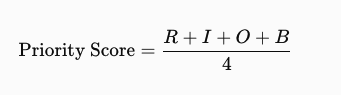
Where \(R\) is relevance, \(I\) is intent alignment, \(O\) is ranking opportunity, and \(B\) is business potential. This is a practical framework, not a standard Google ranking formula.
For example, a highly relevant service keyword may deserve priority even if its search volume is lower than a broad informational keyword.
Example keyword prioritisation table
The following scores are illustrative, not live keyword research data.
| Keyword | Intent | Relevance | Priority |
|---|---|---|---|
| SEO keyword strategy | Informational | 5/5 | High |
| How to do keyword research | Informational | 4/5 | High |
| SEO consultant for ecommerce | Commercial | 5/5 | High |
| What is a search engine | Informational | 2/5 | Low |
| Hire an SEO consultant | Transactional | 5/5 | High |
Your final priorities should also consider ranking difficulty, search demand, existing rankings, resources, and whether you already have a suitable page.
Step 6: Group Related Keywords into Topic Clusters
Keyword clustering means organising closely related queries into groups so you can decide which topics belong on the same page and which need separate pages.
Without clustering, a website may publish multiple articles that answer essentially the same question. This can waste resources and create unnecessary overlap.
For example, these searches could potentially be served by one comprehensive article:
- How to build an SEO keyword strategy
- Steps to create a keyword strategy
- SEO keyword planning process
- How to choose target keywords for SEO
However, “keyword mapping for SEO” may deserve a separate article if the search results indicate a distinct need for a practical mapping tutorial.
How to build useful topic clusters
- Group keywords by subject and search intent.
- Review the search results for overlapping queries.
- Decide which page should serve each group.
- Select one primary topic for each page.
- Include related terms naturally where they help answer the user’s question.
- Connect relevant pages through contextual internal links.
A topic cluster might look like this:
Pillar topic
SEO Keyword Research & Content Strategy
Keyword Strategy
Selection & prioritisation
Keyword Clustering
Grouping related queries
Keyword Mapping
Assigning terms to pages
Content Gap Analysis
Finding missing topics
Each supporting article should serve a distinct purpose and link naturally to relevant related resources.
Step 7: Map Keywords to the Right Website Pages
Keyword mapping assigns target keyword groups to specific URLs. It helps maintain a clear purpose for each page and reduces unnecessary overlap.
A keyword map should include the primary keyword, related terms, search intent, assigned URL, page type, and content status.
Example keyword mapping for an SEO consultant
| Page | Primary keyword | Page type |
|---|---|---|
| Homepage | SEO expert in Bangladesh | Homepage |
| SEO consulting service | SEO consultant in Bangladesh | Service page |
| Keyword strategy article | SEO keyword strategy | Blog post |
| Keyword clustering article | Keyword clustering | Blog post |
| Keyword mapping article | Keyword mapping for SEO | Blog post |
| Technical SEO service | Technical SEO consultant | Service page |
These are example assignments. Validate the actual intent and search results before finalising them.
Avoid targeting every keyword with a separate page
A common mistake is creating a new URL for every slight keyword variation. This can result in repetitive content that provides little additional value.
Instead, ask:
- Can one page fully answer these related searches?
- Do the queries have similar intent?
- Do search results show substantially overlapping pages?
- Would a separate page provide a distinct and useful experience?
If the answers point to the same need, one strong page may be more appropriate than several thin pages.
Step 8: Turn Your Keyword Strategy into a Content Plan
Keyword research becomes useful when it informs what you publish, update, and improve.
Create a content calendar that prioritises pages according to business relevance, search intent, ranking opportunities, and available resources.
For each planned page, document:
- Primary keyword and related search terms
- Target audience and search intent
- Recommended page type
- Questions the content must answer
- Relevant internal links
- Evidence, examples, or original insights to include
- The action you want readers to take
- How you will measure performance
Decide whether to create, improve, or consolidate content
Not every keyword opportunity requires a new article.
Create a new page when the topic serves a distinct user need that your existing content does not satisfy.
Improve an existing page when it already attracts relevant impressions but could answer the query more effectively.
Consolidate overlapping content when multiple pages compete to answer essentially the same question and combining them would create a more useful resource.
Leave a page unchanged when it already serves its purpose well and there is no clear evidence that a change is needed.
A strong content strategy makes better use of existing assets instead of automatically increasing the publishing volume.
Step 9: Optimise Your Keyword Strategy for SEO, GEO, and AI Search
A modern keyword strategy should help both people and search systems understand what your content covers and why it is useful.
GEO (Generative Engine Optimization) and AIO (AI Search Optimization) are terms used for improving content visibility and usefulness in AI-powered search experiences. They should complement—not replace—sound SEO practices.
Write content that answers questions clearly
Start with a direct answer to the main question, then provide the reasoning, steps, examples, and limitations readers need.
For example, if your article targets “SEO keyword strategy,” explain what a keyword strategy is near the beginning before expanding into research methods and prioritisation.
Use clear headings and meaningful terminology
Organise the article into logical sections with descriptive H2 and H3 headings. Explain specialist terms when first introduced and use related concepts naturally.
This improves readability and helps readers locate specific information.
Include original expertise and useful evidence
Where appropriate, add real examples, screenshots, decision frameworks, and lessons from actual projects. Make sure any case-study claims are accurate and can be supported.
Keep information accurate and easy to verify
Cite authoritative sources for external facts, distinguish examples from actual results, and update information when the underlying methods or tools change.
There is no guaranteed formula for appearing in AI-generated answers. Google advises publishers to prioritise helpful, reliable, people-first content rather than producing pages primarily to manipulate rankings.
Step 10: Measure and Refine Your Keyword Strategy
Keyword research is not a one-time task. Search behaviour, competitors, your website, and business priorities can change over time.
Review your performance regularly using Google Search Console, analytics tools, and relevant SEO platforms.
Track metrics such as:
- Organic clicks and impressions
- Search queries and average positions
- Click-through rates for relevant pages
- Organic conversions, enquiries, or sales where tracking is available
- Performance of important landing pages
- New keyword opportunities
- Content that needs updating or consolidation
Use the findings to decide what to improve next. For example, a page with relevant impressions but a low click-through rate may warrant a review of its title and description. A page attracting visitors but generating few enquiries may need a closer look at intent alignment, content usefulness, and conversion experience.
Avoid changing content solely because rankings fluctuate for a short period. Investigate the evidence and consider the context before making substantial changes.
Common SEO Keyword Strategy Mistakes to Avoid
Even a large keyword list will not produce a strong strategy if the underlying decisions are poor.
- Choosing keywords only by search volume: High volume does not automatically mean high business value.
- Ignoring search intent: The wrong page type may struggle to satisfy the searcher.
- Trusting keyword difficulty scores blindly: Metrics are estimates and need manual SERP review.
- Creating a page for every variation: Similar queries may be better served by one comprehensive resource.
- Ignoring existing content: Updating a useful page may be more effective than publishing another article.
- Stuffing keywords into headings and paragraphs: Write naturally and cover the topic comprehensively.
- Publishing without a clear purpose: Each page should meet a specific audience need.
- Measuring traffic alone: Evaluate relevant enquiries, conversions, and other business outcomes where possible.
The best approach is to combine data with human judgement and a clear understanding of your audience.
Frequently Asked Questions about SEO keyword strategy
What is an SEO keyword strategy?
An SEO keyword strategy is a plan for choosing and prioritising search terms based on audience needs, search intent, competition, and business goals. It guides which pages to create, optimise, and connect through internal links.
How do I find the best keywords for my website?
Start with your products, services, and audience questions. Expand seed keywords using keyword research tools, competitor analysis, and Google Search Console. Then assess intent, relevance, demand, difficulty, and business potential before selecting targets.
How many keywords should one page target?
There is no fixed number. Choose one clear primary topic and include related terms and questions where they naturally help satisfy the search intent. The objective is to create a useful page, not to reach a keyword quota.
What is the difference between keyword research and keyword strategy?
Keyword research discovers and evaluates search queries. Keyword strategy uses that research to determine which queries matter most, what pages should target them, and how the work supports broader business goals.
Should I target high-volume or low-competition keywords?
Neither metric should be considered in isolation. Prioritise keywords that are relevant to your audience, have suitable search intent, offer realistic ranking opportunities, and support your business objectives. Some high-competition terms may be worthwhile long-term targets.
How often should I update my keyword strategy?
Review it periodically and when meaningful changes occur, such as new services, changes in customer demand, new competitors, or shifts in search performance. The appropriate frequency depends on your industry and website.
Can keyword research improve AI search visibility?
Keyword research helps you understand the questions and needs your audience expresses through search. Combining that insight with accurate, well-structured, original, and useful content can support discoverability in traditional and AI-powered search experiences, although specific AI citations or visibility cannot be guaranteed.
Final Thoughts: Build a Keyword Strategy Around Business Value
A successful SEO keyword strategy begins with understanding your audience and ends with useful content that meets their needs.
Research relevant search terms, evaluate intent and ranking opportunities, prioritise commercial value, group related queries, and map them to the right pages. Then measure results and refine your approach as new evidence emerges.
Remember: the goal is not to rank for every keyword. It is to help the right people find the right pages—and give them a compelling reason to take the next step.
If you need help identifying valuable keyword opportunities and turning them into a practical SEO roadmap, explore my SEO consulting services or contact Azim for a consultation.

Ready to Build an SEO Keyword Strategy That Drives Results?
The right keywords can connect your business with people actively searching for your products or services. I’ll help you identify valuable search opportunities, understand user intent, prioritise target keywords, and turn your research into a practical content strategy.
Let’s build an SEO strategy focused on relevant traffic, stronger search visibility, and meaningful business growth.