Search is changing.
People are no longer relying only on traditional search results. They are increasingly using conversational and AI-powered experiences to research businesses, compare products, understand complex topics, and find recommendations.
That shift has created a new area of SEO discussion: Generative Engine Optimization (GEO).
What is Generative Engine Optimization?
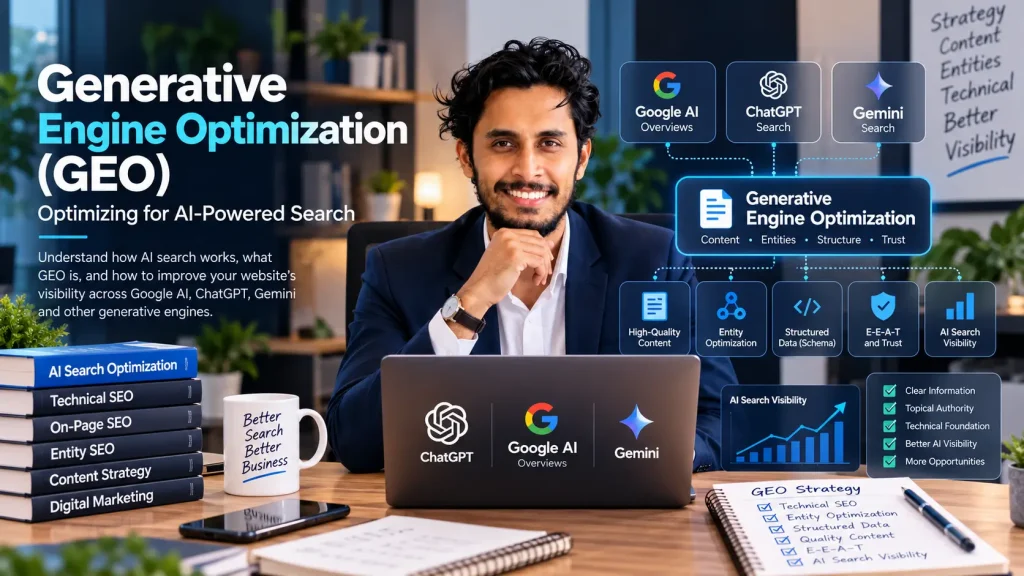
Generative Engine Optimization (GEO) is the practice of improving a website’s content, structure, expertise signals, and digital presence so that AI-powered search systems can better understand, retrieve, and use its information when generating answers.
GEO is not a replacement for SEO. In practice, much of what makes a website technically sound, useful, trustworthy, and understandable for traditional search also supports visibility in generative search experiences.
Google’s current guidance makes this point clearly: its AI features are built on existing Search systems, and the fundamental SEO best practices remain relevant. Google also notes that “GEO” and “AEO” are industry terms rather than a separate set of required Google optimizations.
So the better way to think about GEO is:
GEO is an extension of modern SEO thinking for a search environment where AI systems can interpret information, combine sources, and generate answers.
How Is GEO Different From Traditional SEO?
Traditional SEO has historically focused heavily on helping individual web pages appear for relevant searches.
That still matters.
GEO adds another layer: how clearly your business, expertise, content, products, services, and relationships can be understood across AI-powered search experiences.
For example, traditional SEO might target:
“Shopify SEO expert Bangladesh”
A conversational AI search could instead involve a much broader question:
“Who can help a Shopify store improve technical SEO, product visibility, and organic traffic?”
The second query requires an understanding of more than a single keyword.
An AI system may need to understand:
- Who the provider is
- What services they offer
- What platforms they work with
- Where they operate
- What topics they demonstrate expertise in
- Which pages support those claims
- Whether information across different sources is consistent
This is why entity understanding, topical relevance, clear content, technical accessibility, and trustworthy information matter.
Microsoft’s current Bing Webmaster Tools also uses the language of grounding and citation activity to describe how websites contribute to AI-generated answers across Copilot and related experiences.
GEO Does Not Replace SEO
This is one of the most important points to understand.
You do not need to abandon traditional SEO because AI search is growing.
Google’s official documentation specifically says that existing SEO best practices continue to apply to AI Overviews and AI Mode. Pages still need to meet Google’s technical requirements and be eligible to appear in Search.
That means fundamentals such as:
- Crawlability
- Indexation
- Helpful content
- Internal linking
- Page experience
- Clear website architecture
- Structured data where appropriate
- Search intent
- Relevant content
- Mobile usability
remain important.
A technically broken website cannot become strong in AI search simply because it adds an “AI SEO” section to its homepage.
Think of it this way:
SEO builds the foundation.
GEO helps you organize and strengthen that foundation for AI-driven discovery and interpretation.
Why Does Generative Engine Optimization Matter?
AI-powered search experiences are changing how people discover information.
Google now has AI Overviews and AI Mode, while ChatGPT Search and Microsoft Copilot provide conversational ways to discover information from the web. Google says its AI search experiences can use multiple related searches to explore subtopics and retrieve supporting web pages.
This creates a different type of visibility opportunity.
A customer may not always discover your business by clicking a traditional blue-link result first.
They may encounter your business while asking an AI system:
- “What are the best options for…?”
- “Which company provides…?”
- “Compare these services…”
- “How do I solve…?”
- “Who specializes in…?”
- “What should I consider before buying…?”
Your website needs to provide useful information that can support these kinds of searches.
What Does GEO Optimization Actually Involve?
GEO is not one technical setting or plugin.
It is a broader optimization process involving several areas of your digital presence.
1. Create Clear, Helpful Content
AI systems need information they can understand.
That starts with content written for people.
Instead of publishing generic articles such as:
“10 Amazing SEO Tips You Need Today”
create content that genuinely answers a specific question.
For example:
How to Fix Shopify Duplicate Product URLs
A useful article could explain:
- Why duplicate URLs occur
- Which URLs matter
- How canonical signals work
- What Shopify store owners should check
- When technical implementation may be necessary
Google’s current generative AI guidance emphasizes unique, valuable, non-commodity content and first-hand expertise rather than content created simply to match every possible search variation.
2. Build Topical Authority
One article rarely establishes strong expertise around an entire subject.
Suppose your business provides Shopify SEO.
Instead of publishing one generic article about Shopify SEO, build useful coverage around connected topics:
Shopify SEO
- Shopify technical SEO
- Shopify keyword research
- Product page SEO
- Collection page SEO
- Shopify duplicate content
- Shopify site speed
- Shopify internal linking
- Shopify structured data
- Shopify SEO audits
These topics create a clearer relationship between your website, your expertise, and the subject you want to be known for.
The goal isn’t to publish hundreds of thin articles.
It is to build useful topical coverage with genuine expertise.
3. Strengthen Entity Understanding
This is one of the most important concepts in GEO.
An entity can be a person, company, product, service, organization, location, or other identifiable concept.
For example:
Azim Jamshed → SEO consultant → SEO services → Bangladesh → Technical SEO → Shopify SEO → WordPress SEO → GEO
A well-structured website should make these relationships understandable.
Your About page, service pages, author information, contact details, articles, structured data, and external references should reinforce accurate information about your business.
This helps create a clearer digital identity rather than presenting a website as a collection of disconnected keywords.
4. Demonstrate E-E-A-T
Experience and expertise matter even more when you’re trying to establish authority around a subject.
Your website should clearly communicate:
Experience
What have you actually worked on?
Expertise
What do you understand deeply?
Authoritativeness
Why should someone consider you a credible source?
Trust
Can people understand who is behind the website and verify important information?
For a professional SEO consultant, this could include:
- A detailed About page
- Author information
- Relevant professional experience
- Service expertise
- Original insights
- Real project experience where disclosure is appropriate
- Consistent business information
- Genuine third-party references
- Clear contact information
The important word is genuine.
GEO is not a reason to manufacture expertise or create fake mentions.
5. Structure Content for Easy Understanding
Well-structured content is easier for people to scan and easier for systems to interpret.
Use:
- Clear H2 and H3 headings
- Short paragraphs
- Direct definitions
- Lists where appropriate
- Descriptive titles
- Specific examples
- Logical internal links
- Tables when comparison is useful
- Supporting evidence where appropriate
For example, instead of beginning an article with three paragraphs of general background, answer the question directly:
Generative Engine Optimization is the practice of improving a website’s information and digital presence so AI-powered search systems can better understand and potentially use that information in generated answers.
Then explain the details.
This structure benefits humans first—and that is exactly the direction Google’s guidance recommends for generative AI search.
6. Use Structured Data Correctly
Structured data can help search engines understand specific types of information on a page.
Depending on the website, this may include structured data related to:
- Organization
- Person
- Local business
- Product
- Article
- Breadcrumbs
- Other supported content types
But there is an important misconception to avoid:
There is no special “GEO schema” that guarantees visibility in AI search.
Google explicitly says there is no special schema.org markup required for its generative AI search experiences. It still recommends using structured data appropriately as part of overall SEO, with the markup matching the visible content on the page.
So use schema to improve structured understanding—not as an AI-search hack.
7. Make Your Website Technically Accessible
AI search still depends heavily on information being discoverable and accessible.
For Google AI features, a page needs to be indexed and eligible to appear in Google Search with a snippet. Google also recommends maintaining normal technical SEO fundamentals such as crawlability, internal linking, page experience, and accessible textual content.
That means your GEO strategy should include technical SEO.
Check:
- Robots.txt
- Indexation
- XML sitemap
- Canonicals
- HTTP status codes
- Internal links
- JavaScript rendering
- Mobile usability
- Page speed
- Core Web Vitals
- Duplicate content
- Website architecture
Google’s current GEO guidance specifically emphasizes maintaining a clear technical structure and crawlable content.
8. Build Consistency Across Your Digital Presence
Imagine your website says:
SEO Consultant
But your LinkedIn profile says:
Web Developer
A business directory says something different.
Another profile lists different services.
An article describes your company differently again.
That creates unnecessary ambiguity.
Your important information should be consistent across relevant platforms:
- Business name
- Person/brand identity
- Services
- Location
- Expertise
- Website
- Professional profiles
- Relevant publications
This doesn’t mean creating hundreds of profiles simply to generate “mentions.”
Google specifically warns against pursuing inauthentic mentions as a GEO tactic.
The goal is accurate digital consistency, not artificial authority.
GEO for Local Businesses
Generative search isn’t only relevant to national brands.
Local businesses can also benefit from making their business information clearer.
Consider a user asking:
“Who are some reliable plumbers near me?”
or:
“What are some SEO agencies that work with small businesses in Bangladesh?”
For a local business, useful information can include:
- Business name
- Services
- Location
- Service areas
- Business profile information
- Website content
- Reviews
- Relevant local pages
- Contact information
Google’s current guidance notes that generative AI responses can include local business information and recommends keeping Business Profile information up to date where relevant.
This is where Local SEO and GEO overlap naturally.
GEO for Ecommerce Websites
Ecommerce businesses have another opportunity: making product information clear and consistent.
Your website should clearly communicate:
- Product names
- Product attributes
- Categories
- Brands
- Specifications
- Pricing information
- Availability where appropriate
- Product descriptions
- Customer questions
- Buying guidance
- Related products
Google’s generative AI guidance specifically points to shopping and product information as areas where AI experiences can surface relevant information.
For an ecommerce brand, GEO should therefore be connected with:
Ecommerce SEO + Product SEO + Technical SEO + Structured Data + Useful Content
—not treated as a completely separate activity.
GEO vs AEO vs SEO
These terms are often used interchangeably, but they have slightly different emphasis.
| Approach | Main Focus |
|---|---|
| SEO | Search visibility and organic search performance |
| AEO | Providing direct answers to questions |
| GEO | Visibility and information understanding in generative AI experiences |
There is significant overlap between them.
Google itself describes AEO and GEO as terms used in the industry for work focused on AI search visibility, while framing the underlying work as part of optimizing for the search experience.
For most businesses, you don’t need three completely separate strategies.
A strong approach combines:
Technical SEO + Helpful Content + Entity Understanding + Topical Authority + Structured Information + Clear Brand Signals
What GEO Is NOT
There is a lot of misinformation around AI search optimization.
GEO is not keyword stuffing
Repeating “Generative Engine Optimization” 50 times won’t make an article more useful.
GEO is not a guarantee of AI citations
No legitimate SEO consultant can guarantee that ChatGPT, Google AI, Gemini, or another system will cite a specific page.
GEO is not just adding an llms.txt file
Google’s current guidance says llms.txt is not required for Google Search and does not improve or harm Google Search visibility.
GEO is not writing tiny content blocks for AI
Google says there is no requirement to “chunk” content into tiny pieces for generative AI systems. Content length and structure should serve the audience and topic. GEO is not fake brand mentions
Creating artificial mentions simply to make an AI system “notice” your brand is not a sustainable strategy.
GEO is not replacing SEO
Your technical SEO foundation still matters.
How to Start Generative Engine Optimization
If you want to prepare your website for AI-powered search, start with the fundamentals.
Step 1: Audit Your Existing Website
Check:
- Indexation
- Crawlability
- Site architecture
- Content quality
- Internal links
- Structured data
- Business information
- Author information
- Page experience
Step 2: Identify Your Core Entities
Define:
- Who you are
- What your business offers
- Who you serve
- Where you operate
- What subjects you specialize in
- Which products or services are most important
Step 3: Map Your Topics
Create a topic structure around your core expertise.
Identify the questions your customers ask before choosing your service or product.
Step 4: Improve Existing Content
Don’t automatically publish more.
First improve pages that already have potential but lack clarity, depth, evidence, or useful structure.
Step 5: Build Supporting Content
Create articles, guides, comparisons, FAQs, case studies, and other resources that genuinely help your audience.
Step 6: Strengthen Internal Connections
Connect related services, articles, categories, authors, products, and supporting pages.
Step 7: Maintain Consistency
Keep important business and brand information accurate across your website and relevant external properties.
Step 8: Measure What You Can
Traditional Search Console data remains useful. Google now provides reporting for generative AI features within Search Console, while Bing Webmaster Tools has an AI Performance report that can show pages, queries, and citation activity across supported AI experiences.
The exact reporting available can change as these platforms evolve, so avoid treating any third-party “AI visibility score” as an official ranking metric.
How Azim Jamshed Approaches GEO
Generative Engine Optimization should not be treated as a standalone collection of AI tricks.
My approach combines SEO, technical website optimization, content strategy, entity understanding, structured information, and E-E-A-T.
I focus on helping businesses make their online information:
- Clearer
- More consistent
- Easier to discover
- Better structured
- More useful to customers
- More strongly connected to their core expertise
This can involve reviewing your website architecture, content, internal links, structured data, author information, service pages, topical coverage, and broader digital presence.
My existing Generative Engine Optimization service follows this same principle: GEO works alongside SEO rather than replacing it. SEO Expert Azim
For websites with technical barriers, I also provide Technical SEO services covering crawling, indexing, site architecture, structured data, Core Web Vitals, internal linking, and other technical foundations. SEO Expert Azim
For businesses dependent on local visibility, Local SEO services can complement GEO by strengthening business information, location relevance, local content, and Google Business Profile optimization. SEO Expert Azim
For ecommerce brands, my Shopify SEO services also cover product pages, collections, technical SEO, structured data, search intent, and AI Search/GEO optimization. SEO Expert Azim
Frequently Asked Questions About Generative Engine Optimization
What is Generative Engine Optimization?
Generative Engine Optimization (GEO) is the practice of improving a website’s content, structure, expertise signals, and digital presence so AI-powered search systems can better understand and potentially use its information when generating answers.
Is GEO the same as SEO?
No, but they overlap heavily. GEO focuses more explicitly on AI-powered and generative search experiences, while traditional SEO focuses on organic search visibility more broadly. Google states that existing SEO fundamentals remain relevant to its generative AI search features.Does GEO replace traditional SEO?
No. Technical SEO, helpful content, crawlability, indexing, internal linking, structured information, and good page experience remain important foundations.
Can GEO guarantee ChatGPT or Google AI citations?
No. AI systems decide which information to surface based on their own retrieval and ranking processes. No legitimate provider can guarantee that a particular page will be cited in a generated answer.
Does structured data help with GEO?
Structured data can help search engines understand supported content and entities, but there is no special GEO schema that guarantees AI visibility. Google recommends using structured data appropriately and ensuring it matches visible page content.
Do I need an llms.txt file for GEO?
Not for Google Search. Google’s current guidance says an llms.txt file is not required for Google Search and does not improve or harm Google Search visibility. Other AI systems may have their own approaches, so website owners should evaluate such recommendations individually.
How can I optimize my website for AI Overviews?
Start with the same fundamentals that support strong Google Search performance: create helpful original content, maintain crawlability and indexation, use clear site architecture and internal links, provide a good page experience, and ensure structured data accurately reflects visible content.
How do I start with GEO?
Begin with a website and content audit. Identify your important entities, services, topics, expertise signals, technical issues, and content gaps. Then prioritize improvements based on your business goals rather than trying to implement every emerging AI-search tactic.
Final Takeaway
Generative Engine Optimization is not about finding a secret trick to make AI systems mention your brand.
It’s about building a digital presence that is useful, accurate, technically accessible, clearly structured, authoritative, and easy to understand.
The businesses best positioned for AI-powered search are not necessarily the ones using the most “AI SEO” terminology.
They are the ones with strong information ecosystems:
Good SEO → Useful Content → Clear Entities → Strong Expertise → Consistent Information → Better Search Understanding
As AI search continues to evolve, the specific interfaces and measurement tools will change. The underlying principle is much more stable: help people, make your information clear, and build a website that search systems can access and understand.
Ready to Optimize Your Website for AI Search?
If your business wants to prepare for Google AI Overviews, AI Mode, ChatGPT Search, Gemini, and other AI-powered discovery experiences, start with your existing SEO foundation rather than chasing unproven shortcuts.
I can review your website’s technical SEO, content structure, entities, internal linking, topical coverage, structured data, and E-E-A-T signals and identify practical opportunities for stronger AI-search readiness.