
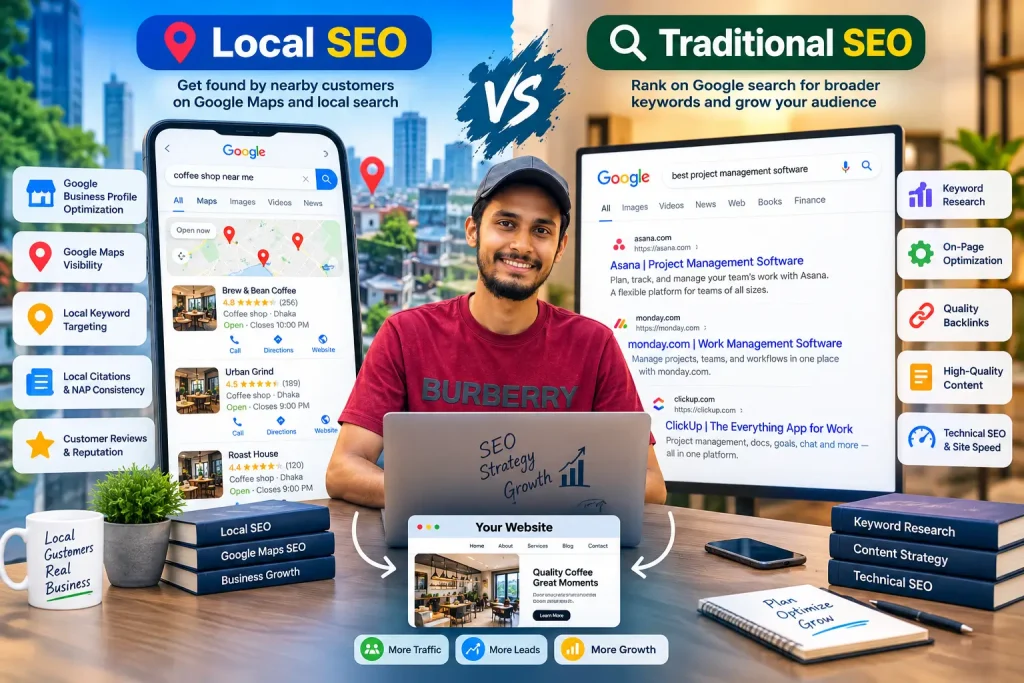
If you are trying to improve your business’s visibility on Google, you may have come across two terms: Local SEO and Traditional SEO.
They share many of the same foundations, but they are designed around different search situations.
Traditional SEO generally focuses on improving a website’s visibility for relevant searches across broader geographic areas. Local SEO focuses more specifically on searches connected to a particular location, service area, or nearby business.
For example, someone searching for “best accounting software” has a very different intent from someone searching for “accountant in Dhaka.”
Both searches can involve SEO, but the optimization strategy can be quite different.
Understanding the difference between Local SEO vs Traditional SEO can help you decide where to invest your time, content, and marketing resources.
What Is Traditional SEO?
Traditional SEO is the broader practice of improving a website’s visibility in organic search results.
It can involve:
- Keyword research
- Search intent analysis
- Content optimization
- Technical SEO
- Internal linking
- Website architecture
- Backlink development
- On-page SEO
- Structured data
- Website performance
- Content quality
The objective is to make a website easier for search engines to discover, understand, and match with relevant searches.
For example, a software company selling project management tools may target searches such as:
- Project management software
- Best project management tools
- Project management software for small businesses
- How to manage remote teams
These searches may not have a specific geographic requirement.
Traditional SEO can therefore be useful when a business wants to reach a broader audience across a country or internationally.
What Is Local SEO?
Local SEO focuses on improving a business’s visibility when people search for products or services within a specific geographic area.
These searches can include:
- Dentist in Dhaka
- SEO expert near me
- Restaurant in Gulshan
- Plumber in Chattogram
- Moving company in Doha
- Real estate agent in Toronto
Local SEO can involve both the business’s website and its Google Business Profile.
Google explains that local results appear across Google Search and Maps, and that local ranking is primarily influenced by relevance, distance, and prominence.
That makes location an important part of the optimization process.
Local SEO vs Traditional SEO: Key Differences
The biggest difference is search intent and geographic relevance.
| Factor | Local SEO | Traditional SEO |
|---|---|---|
| Main focus | Local visibility | Broader organic visibility |
| Geographic targeting | Important | May not be necessary |
| Google Business Profile | Often important | Usually not central |
| Google Maps | Important | Generally not the primary focus |
| Location keywords | Often important | Optional |
| Local citations | Can be important | Usually less central |
| Location pages | Often useful | Depends on business |
| Website SEO | Important | Important |
| Content | Local + service-focused | Topic + search-intent focused |
| Target audience | Customers in specific areas | Broader or global audiences |
The two approaches are not competitors. In many cases, a business benefits from both.
Google Business Profile and Local SEO
One of the clearest differences between Local SEO and traditional SEO is the importance of the Google Business Profile.
A properly managed Business Profile can provide Google with useful information about a business, including its name, category, location, hours, services, photos, and other details.
Google recommends keeping business information complete and accurate and responding to customer reviews.
However, simply creating a profile does not guarantee a particular position in Google Maps.
Google states that local results are mainly based on relevance, distance, and prominence.
This is why Local SEO should be treated as a broader strategy rather than simply “optimizing a Google listing.”
How Traditional SEO and Local SEO Overlap
Although they have different goals, both strategies share many fundamentals.
Technical SEO
Your website still needs to be crawlable, indexable, fast, mobile-friendly, and logically structured.
On-Page SEO
Titles, headings, content, URLs, internal links, and other on-page elements still matter.
Search Intent
You need to understand what users actually want when they perform a search.
Content
Useful, relevant content can help demonstrate expertise and provide answers to potential customers.
Website Experience
A visitor who lands on your website should be able to quickly understand what you offer and how to contact you.
So, Local SEO does not replace traditional SEO.
It adds geographic context to a broader search strategy.
When Should a Business Focus on Local SEO?
Local SEO is particularly relevant when customers need to visit your business or when you provide services within a defined area.
Examples include:
- Restaurants
- Dental clinics
- Healthcare providers
- Law firms
- Real estate businesses
- Construction companies
- Plumbers
- Moving companies
- Landscaping businesses
- Automotive services
- Beauty salons
- Local retailers
- Professional services
For these businesses, searches containing a city, neighbourhood, service area, or “near me” intent can be commercially valuable.
When Is Traditional SEO More Appropriate?
Traditional SEO can be more relevant when geographic location is not a major part of the customer’s decision.
For example:
SaaS Companies
A software company may target users across multiple countries.
Ecommerce Brands
An online store may sell products nationally or internationally.
Publishers and Blogs
A content website may target informational searches from users anywhere in the world.
Online Education
An online course provider may target learners across multiple markets.
International Businesses
Companies operating across several countries may require a combination of traditional and international SEO.
In these cases, focusing exclusively on local search could unnecessarily limit the potential audience.
Can a Business Use Both Local SEO and Traditional SEO?
Yes.
In fact, many businesses should.
Consider a digital marketing agency serving businesses in Bangladesh.
It might target broader searches such as:
“SEO services”
while also targeting location-specific searches such as:
The first search has broader intent.
The second contains a clear geographic element.
A combined strategy could therefore include:
- Technical SEO
- Service page optimization
- Helpful educational content
- Local keyword research
- Google Business Profile optimization
- Location pages
- Local business information
- Internal linking
- Relevant citations
- Review management
This creates a broader organic presence while still addressing customers who are searching locally.
Local SEO for Businesses in Bangladesh
For businesses operating in Bangladesh, Local SEO can be particularly useful when customers search by city or service area.
Depending on where the business operates, search behaviour may include locations such as:
- Dhaka
- Chattogram
- Sylhet
- Rajshahi
- Khulna
- Cumilla
- Gazipur
But location targeting should reflect the actual areas a business serves.
Creating dozens of city pages with little useful information simply to target keywords can create a poor user experience.
A better approach is to create genuinely useful location content that explains the services available in that area.
How Local SEO and Website SEO Work Together
Your Google Business Profile is only one part of your local search presence.
Your website also provides important context.
For example, a local service business may have:
Homepage → Service Pages → Location Pages → Supporting Content
A location page might explain:
- Which services are available
- Where the business operates
- What customers can expect
- Local service considerations
- How to contact the business
- Relevant FAQs
Internal links can then connect these pages together logically.
This helps users navigate the site while creating clearer relationships between services and locations.
Does Local SEO Mean You Only Need Google Maps?
No.
This is a common misconception.
Local SEO can involve several parts of your online presence, including:
- Google Business Profile
- Website
- Local landing pages
- Local keyword targeting
- Business citations
- Reviews
- Internal linking
- Structured data
- Local content
- Relevant links and mentions
Google’s documentation also notes that prominence can be influenced by information from across the web, including links and reviews.
Your website therefore remains an important part of the overall strategy.
Local SEO vs Traditional SEO: Which One Do You Need?
The answer depends on how your customers search and where your business operates.
Choose a stronger Local SEO focus if:
- You serve customers in specific locations.
- Customers visit your physical location.
- You provide services within defined areas.
- Google Maps visibility matters to your business.
- Location-specific searches generate valuable leads.
Focus more heavily on Traditional SEO if:
- You serve a national or international audience.
- Your business is primarily online.
- Geographic location is not important to customers.
- You publish informational content for a broad audience.
- You operate a SaaS or digital business.
Consider both if:
Your business has local customers but also wants broader organic visibility.
This is common for agencies, professional services, ecommerce businesses, education companies, healthcare brands, and growing service businesses.
How to Build a Combined SEO Strategy
A practical approach is to start with the fundamentals.
Step 1: Understand Your Customers
Identify what people search for, where they search from, and what they expect to find.
Step 2: Separate Local and Non-Local Keywords
Create groups for:
Local intent:
“SEO expert in Dhaka”
Broader intent:
“technical SEO services”
This makes it easier to build appropriate pages.
Step 3: Strengthen Your Website
Make sure important pages are technically accessible, useful, fast, and logically connected.
Step 4: Optimize Your Google Business Profile
Keep business information complete and accurate and make sure it reflects the actual business.
Step 5: Create Useful Local Pages
If you serve multiple areas, create location pages only where you can provide genuinely useful, unique information.
Step 6: Build Local Relevance
Maintain accurate business information across relevant platforms and develop legitimate mentions and links where appropriate.
Step 7: Measure the Right Things
Don’t focus only on rankings.
Look at:
- Organic traffic
- Local visibility
- Search queries
- Website engagement
- Calls
- Form submissions
- Directions
- Leads
- Conversions
The right metrics depend on your business model.
How Azim Jamshed Approaches Local SEO
For businesses that need local visibility, Azim Jamshed provides Local SEO services focused on Google Search, Google Maps, business information, local keyword research, location pages, citations, reviews, on-page SEO, and website improvements.
His broader SEO work also covers technical SEO, WordPress, Shopify, ecommerce, and AI Search Optimization, allowing local search strategy to be connected with the wider website and SEO structure.
The approach is not based on a generic checklist. Local SEO strategy is adapted to the business, target locations, services, competition, and customer search behaviour.
If your website also has technical problems, those should be addressed as part of the broader SEO foundation. Technical SEO can include crawlability, indexing, redirects, site architecture, internal linking, structured data, Core Web Vitals, and mobile usability.
Final Takeaway
Local SEO vs Traditional SEO is not really a choice between two completely separate systems.
Traditional SEO focuses on broader organic visibility, while Local SEO adds geographic relevance for businesses that depend on specific locations or service areas.
If your customers search for your services in a particular city or region, Local SEO can become an important part of your strategy. If you serve a broader audience, traditional SEO may play a larger role.
For many businesses, the most practical approach is to combine both.
The key is to understand who your customers are, what they search for, where they are located, and what you want them to do after finding your business.
FAQs
Is Local SEO different from SEO?
Local SEO is a specialized part of SEO focused on searches with geographic or local intent. It uses many traditional SEO principles while adding location-focused signals and strategies.
Is Local SEO only for businesses with physical stores?
No. Service-area businesses can also benefit from Local SEO when they serve customers within specific geographic areas.
Does Local SEO help with Google Maps?
Yes. Local SEO can support visibility in Google Maps and local search. Google says local results are primarily influenced by relevance, distance, and prominence.
Can I do Local SEO and Traditional SEO together?
Yes. A business can optimize its website for broader organic searches while also developing location-specific visibility.
Do I need a Google Business Profile for Local SEO?
For eligible local businesses, a Google Business Profile is an important part of local search presence. Keeping the information complete and accurate can help Google understand the business.
Which SEO strategy is right for my business?
It depends on your customers, service area, business model, and search behaviour. Businesses serving specific locations often need Local SEO, while national, international, and online businesses may need broader SEO strategies.
Need Help With Local SEO?
If your business depends on customers finding you in a specific city or service area, your SEO strategy should reflect that.
From Google Business Profile optimization and local keyword research to location pages, citations, website optimization, and technical SEO, a well-structured strategy can help create a stronger local search presence.
Want to understand where your website stands in local search?
👉 Explore Local SEO services from Azim Jamshed and discuss your business goals.